
How to prepare a garden for winter without stripping it bare

A winter-ready garden does not have to look empty. A clear route to the back door, stable containers and plants protected from avoidable damage matter more than cutting every stem to the ground. Some of the dry growth that looks untidy in October still gives the garden shape and offers food or shelter to wildlife through colder months.
The useful question is not “What can I remove?” but “What might fail, obstruct access or damage a plant if I leave it?” Start with those problems. Then decide what can stay until spring. This makes a smaller, more purposeful job and avoids the familiar regret of cutting a border clean only to find it bare for four months.
The RHS advice on perennial cutting back allows for either an autumn cut or leaving many stems for winter interest and habitat. It also identifies exceptions: some tender perennials are better left with old stems protecting their crowns until frost risk has passed. That is a reminder to identify the plant before treating an entire border in one sweep.
Start with access, water and anything loose
Walk through the garden using the routes you need in ordinary winter weather. Sweep leaves from steps and paving, clear drain covers, and check that gates open freely. A path does not need to be spotless, but it should be visible and usable. Where water regularly pools, note the location and what happens after rain. Do not assume one winter tidy will fix an underlying level or drainage issue.
Look up as well as down. A loose trellis, damaged fence panel, unstable pot or dead branch above a busy route deserves attention before a windy spell. Avoid pulling at large or high branches from a ladder. If a tree or substantial limb needs assessment, use a suitable professional rather than treating it as routine pruning. For modest garden tasks, a sensible garden maintenance visit can cover paths, containers and planting without requiring a full clearance.
Keep runoff paths open. Leaves and debris against gullies, air bricks or a threshold are worth moving promptly. In a compact garden, a quick check after heavy rain can tell you more than one ambitious autumn workday. Take photos of recurring wet patches before changing surfaces or soil, since the pattern may matter later.
Leave useful growth standing, selectively
Dry seedheads, ornamental grasses and sturdy perennial stems can make a winter border feel alive. The RHS wildlife gardening guidance notes that delayed cutting of perennials can leave hollow stems and foliage for overwintering invertebrates. Birds may also use some seedheads. None of this means every collapsed plant must remain where it lies.
Choose a few groups with sound, upright stems and interesting form. Leave them until late winter or spring, then cut them with care. Remove growth that has turned into a wet mat over a plant crown, is spilling across a path, or shows disease that merits disposal. The RHS seasonal advice similarly treats leaving stems as an option and advises delaying harder cuts on penstemons until spring. The right decision is plant-specific, not a blanket “clear” or “leave”.
If a border is beside the only path, shorten the stems that lean into it and leave the back of the clump standing. In a narrow garden, this kind of partial edit can keep movement easy while retaining structure. Use clean, sharp tools and avoid wrenching stems from the crown. Set aside any material that appears diseased rather than dropping it around healthy plants.
Treat leaves according to where they land
On a short lawn, a dense leaf layer can block light and smother grass. On a planted bed, a loose covering of healthy leaves can be useful. Sweep and rake with those different surfaces in mind. The detailed choices for a compact space are in our guide to fallen leaves in a small garden; that article should be available before this one publishes.
Avoid pushing all the leaves into one deep heap over low plants. Clear entrances and lawn first, then distribute an appropriate amount under established shrubs or collect it for leafmould. Check for litter and obvious plant disease. If the pile is already sheltering wildlife, lift and sort it gently rather than digging through it blindly with a fork. The purpose is to manage the material, not erase the season from the garden.
If leaves fall for several weeks, a small repeating routine works better than one exhaustive clearance. The autumn maintenance checklist helps prioritise those short visits. One pass may restore the path while another attends to the lawn after the next windy night.
Check containers before a cold, wet spell
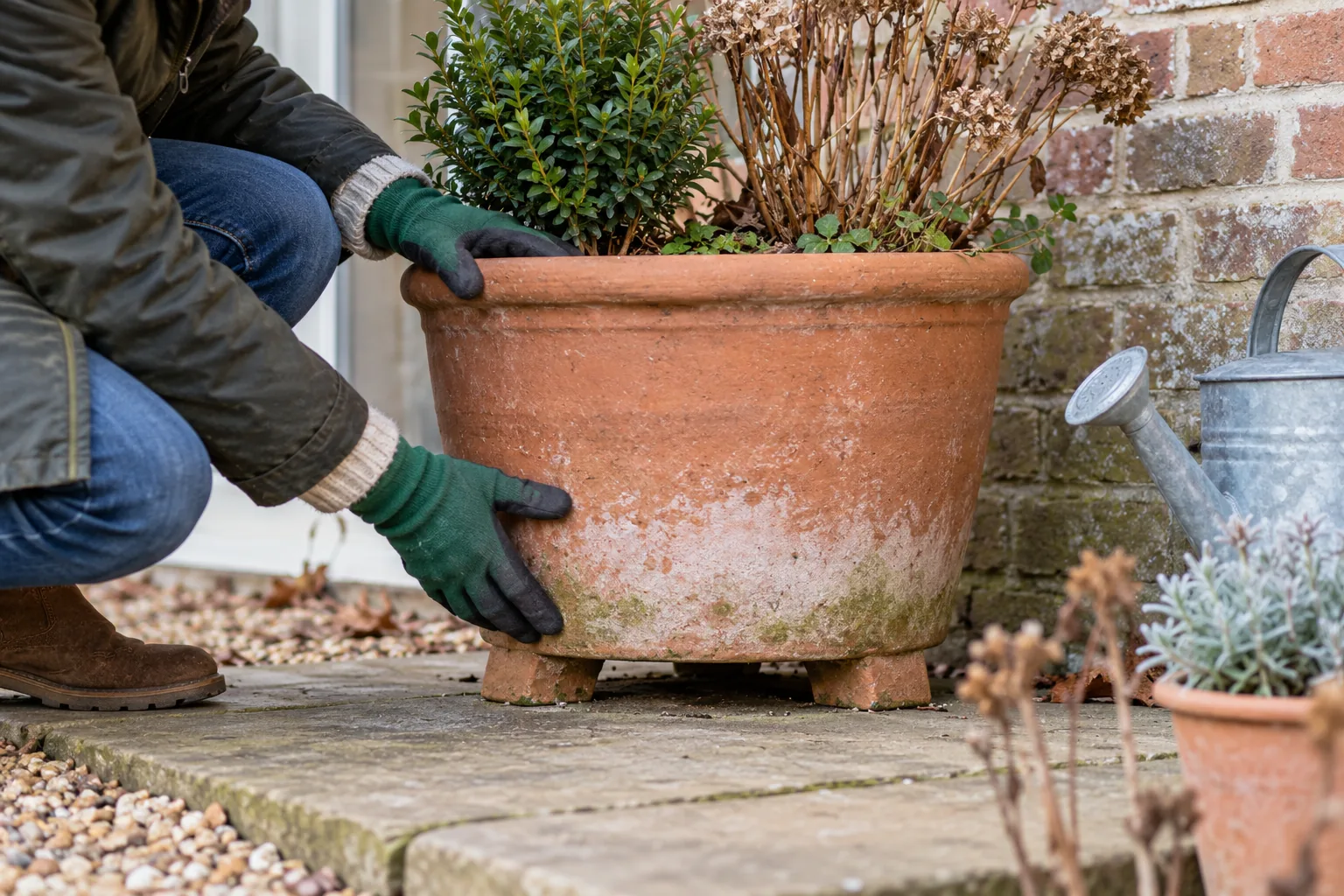
Pots often need more attention than a mature shrub in open ground. Check that each container has a drainage opening and is not sitting permanently in a saucer full of water. Raise heavy pots safely where appropriate, using stable feet or supports suited to the container, and make sure the arrangement cannot topple. Move a vulnerable pot to a more sheltered position if the plant's needs and the available space justify it.
Do not wrap every plant simply because winter is approaching. Frost tolerance differs by species, cultivar and growing conditions. Check the plant label or a reliable species guide, especially for recently acquired or borderline-hardy plants. If protection is needed, choose a method that still allows you to inspect the plant and keep the covering secure in wind. Wrapping a wet plant tightly with unsuitable material can create a different problem.
Watering does not stop automatically in winter. Containers under eaves may miss rain, while others may stay saturated. Feel the compost and respond to the actual condition. Avoid watering frozen compost or adding water to a pot that cannot drain. Remove fallen leaves that are clogging the pot surface or hiding the crown, while leaving suitable mulch where it helps.
Plan pruning rather than cutting by calendar alone
The fact that growth has slowed does not make every plant ready for pruning. Spring-flowering shrubs may carry the buds for next year's display. Other plants respond better to pruning at a different point in their cycle. Before you cut, identify what it is, why you are cutting it, and whether the branch is dead, damaged or merely in the wrong place.
Do not use a winter tidy as an excuse to reduce every shrub to the same outline. That can remove flowering wood and leave a cramped garden with more vigorous regrowth to manage later. If a branch is crossing a path, a targeted cut may solve the immediate problem. If the plant has outgrown the whole space, plan a considered renovation or replacement rather than repeated indiscriminate clipping.
Check for wildlife before work. Birds can nest outside an expected neat calendar window, and protected species or protected trees may impose restrictions. For substantial tree work, obtain advice and check the relevant permissions before anyone cuts. A routine tidy can usually proceed around the issue while the uncertain part is assessed. The principle is straightforward: a clear path is urgent; a cosmetic reshape often is not.
Keep the soil and lawn out of the firing line
Wet soil is easily damaged by heavy foot traffic and repeated work. If boots leave deep marks in a border or footprints persist in soft turf, postpone non-urgent digging, edging and repair. Use the existing path to reach jobs where possible. Do not create a new muddy route across grass simply to reach a corner that can wait until the surface firms.
Likewise, a lawn may need less activity, not more, in winter. Remove leaf blankets and litter, then let it rest when it is waterlogged or frosty. A lawn repair plan made from observations can be useful now, but seed or turf work needs suitable conditions. If the garden suffers repeated winter pooling, note how long water remains and whether runoff from paving or neighbouring ground is involved. That evidence will guide a later garden design discussion more effectively than guessing at a quick fix.
Beds do not have to be dug over merely to look attended. A layer of appropriate organic material on exposed soil can protect the surface and be incorporated gradually by soil life. Keep it away from plant stems and avoid burying small evergreen foliage. Where the bed is already planted and covered, observe it before adding more. Winter preparation should leave the soil in a sounder condition, not merely darker and neater in a photograph.
Give yourself a short, realistic checklist
On a dry day, make one circuit with four priorities. First, clear the routes, steps and drains. Second, secure or set aside anything likely to blow over. Third, check vulnerable containers and any plants with a known need for protection. Fourth, remove only the collapsed, diseased or obstructive growth from the borders. Mark the rest for another date.
Keep a brief note of what you left: seedheads, sturdy grass clumps, healthy leaf litter beneath shrubs, and plants whose pruning time is uncertain. This is useful if someone else helps with the next visit. “Tidy the garden” is too vague when some of the apparent mess is intentional. Specify what should be kept and what needs clearing.
If there is more material than you can store or manage, garden clearance can deal with the excess. Ask for selective work: open the paths, remove diseased or bulky waste, and retain the plants and winter structure you value. A garden prepared this way remains usable through poor weather and still has something worth looking at from the window.